

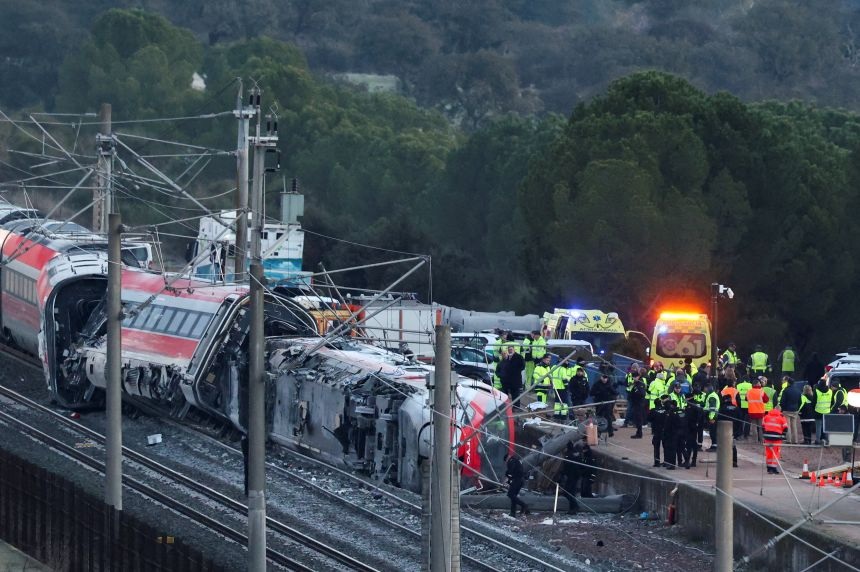
Spain was plunged into mourning after a devastating train collision in the country’s south left at least 39 people dead and dozens more injured, marking the nation’s deadliest rail crash in more than ten years. The incident unfolded near the town of Adamuz in the province of Córdoba on Sunday evening, when a Madrid-bound train derailed, crossed onto the opposite track and slammed into an oncoming service traveling south.
Collision on a straight stretch of track
Rail infrastructure operator Adif said the crash occurred at 7:45pm local time, roughly an hour after the Málaga-to-Madrid train departed. The derailment happened on a straight section of track outside Córdoba, a detail that has intensified questions over how the accident could have occurred.
Transport Minister Óscar Puente described the event as “extremely strange,” warning that the death toll “is not yet final” as investigators work to establish what went wrong.
Around 400 onboard, dozens still hospitalized
Rail networks reported that about 400 passengers and staff were on the two trains combined. Emergency teams treated 122 people at the scene or in nearby medical facilities. Authorities said 43 people — including four children — remained in hospital, while 12 adults and one child were receiving intensive care.
Puente said the force of the impact pushed carriages of the second train into an embankment, adding that most of the fatalities and serious injuries were concentrated in the front carriages of the southbound service.
Rescue teams battled twisted wreckage through the night
Recovery efforts continued through the night, with rescue crews struggling to reach those trapped inside mangled carriages. Córdoba’s fire chief Francisco Carmona said the scale of the damage made the operation especially difficult, describing painstaking work required to access survivors.
RTVE journalist Salvador Jimenez, who was traveling on one of the trains, said the impact felt like “an earthquake,” recalling the moment the train left the tracks.
Images from the site showed several carriages tipped onto their sides as emergency workers climbed over the wreckage and pulled passengers out through doors and windows.
Rail links suspended, stations set up for families
All rail services between Madrid and Andalusia were suspended after the crash and were expected to remain shut throughout Monday. Private operator Iryo said about 300 passengers were onboard the train that first derailed, while the second service — run by state-backed Renfe — carried around 100.
Adif said support spaces for relatives were established at major stations including Atocha, Seville, Córdoba, Málaga and Huelva. Advanced medical posts were also set up to treat injured passengers and coordinate transfers to hospitals.
The Spanish Red Cross deployed emergency support units to the scene and offered counselling to families seeking information. Red Cross representative Miguel Ángel Rodríguez said relatives were experiencing intense anxiety due to uncertainty and a lack of updates in the immediate aftermath.
Leaders respond as investigation begins
Prime Minister Pedro Sánchez said Spain would endure “a night of deep pain,” while Adamuz mayor Rafael Moreno — among the first to arrive at the scene — described the crash as “a nightmare.”
King Felipe VI and Queen Letizia said they were following developments “with great concern,” extending condolences to the families of the victims and wishing the injured a swift recovery.
Condolences also poured in from abroad, with statements issued by French President Emmanuel Macron, Italian Prime Minister Giorgia Meloni and European Commission President Ursula von der Leyen.
Officials said the cause of the collision remained unknown, and the transport minister cautioned that determining what happened may take at least a month.
A tragedy that recalls Spain’s 2013 crash
The disaster revived memories of Spain’s 2013 derailment in Galicia, which killed around 80 people and injured many more. Spain operates one of the world’s largest high-speed rail systems, connecting more than 50 cities across a network stretching over 4,000km.