

Who won , who lost in football
Election nights are usually remembered for winners. Yet sometimes the more interesting story lies in where the winner did not win.
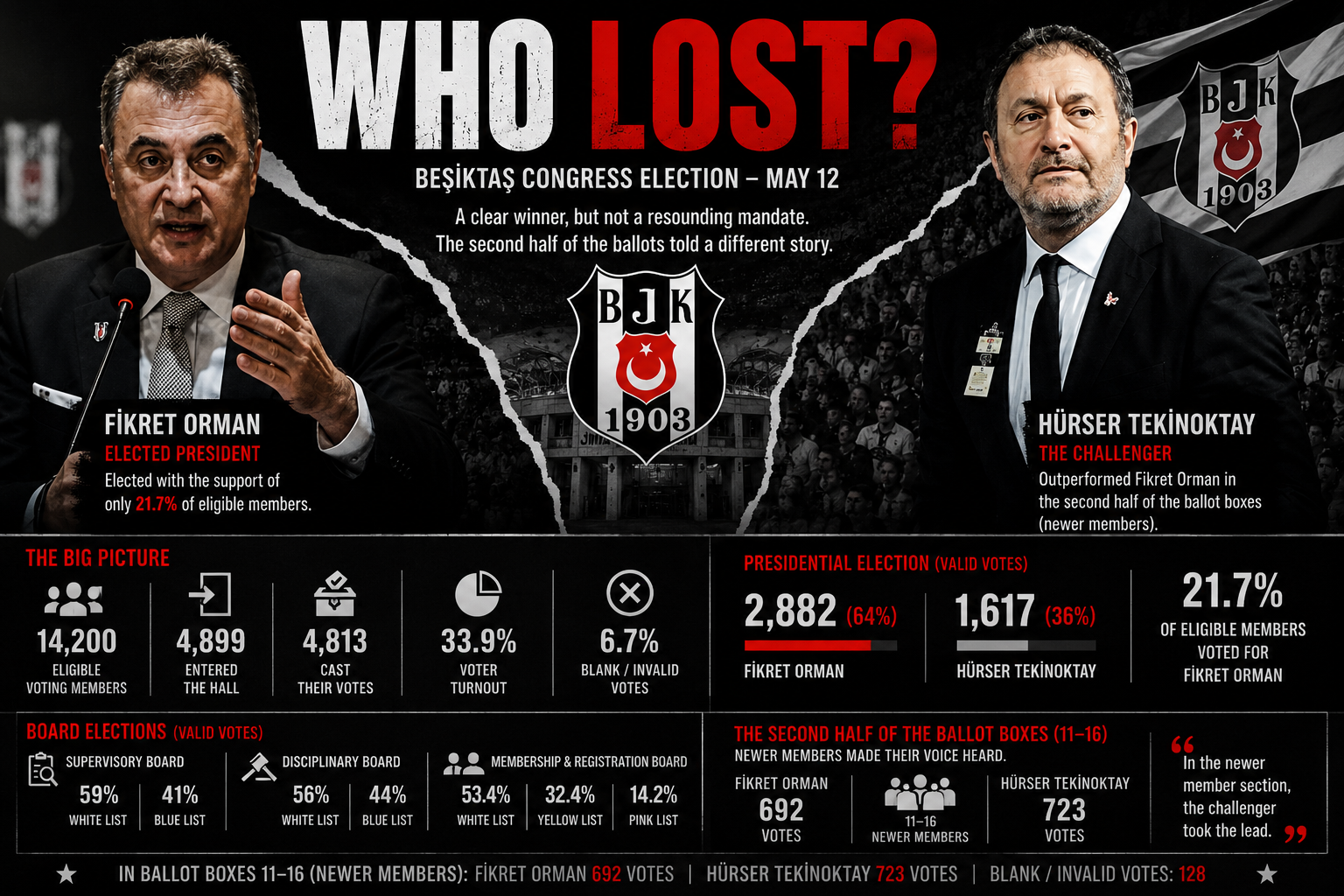
When Fikret Orman defeated Hürser Tekinoktay in Beşiktaş’ presidential election, the headline was straightforward. Orman secured 64 percent of the valid vote and won comfortably.
The broader narrative seemed equally clear: a successful former president, backed by an established network and fresh from a period that would later include two league titles, had defeated a challenger with neither comparable political machinery nor institutional support.
But the ballot-box breakdown tells a more nuanced story.
Tekinoktay was not a former president, a major businessman, or a figure backed by the traditional centres of influence within the club. He was best known as a former coach and football man whose campaign was built largely around criticism of the existing order. On paper, he appeared heavily outmatched.
Yet among members who had joined more recently those voting in ballot boxes 11 through 16 the election looked remarkably different. In those sections, Tekinoktay received 723 votes to Orman’s 692. The margin was small, but politically significant.
The numbers suggest that Beşiktaş was not simply choosing between two candidates. It was revealing a generational divide.
Older members overwhelmingly preferred continuity. Many had longer relationships with the club’s traditional structures, stronger personal networks and, perhaps, greater trust in familiar figures. For them, Orman represented stability.
Newer members appeared less attached to those traditions. Their voting patterns suggest a greater willingness to challenge the established hierarchy and consider an outsider candidacy.
That divide matters because institutions often reveal their future before they reveal their present.
From a purely electoral perspective, Hurser Tekinoktay lost decisively. From a political perspective, however, he demonstrated something more important: that a candidate with limited organisational resources could compete and even prevail among the club’s newer generations of voters.
The significance of that achievement becomes clearer when viewed against the broader context. Orman was not merely another candidate. He would go on to become one of the most successful presidents in modern Beşiktaş history, presiding over a period that delivered consecutive league championships and restored the club’s competitive standing.
Seen from that perspective, the fact that Tekinoktay managed to outperform him among newer members becomes less a footnote and more an indication of an undercurrent within the electorate. It suggested that a substantial portion of the congress was looking for representation beyond the traditional power structures long before such debates became mainstream.
History tends to remember winners. Election data sometimes remembers something else: the first signs of change.